Join the Longevity Collective and our shared goal of longer, healthier lives. Coming Soon!

Now introducing, explore what’s new!

Subcribe for a Free Sample

Subscribe for a Free Sample

Subscribe for a Free Sample

Subscribe for a Free Sample

Jan 15, 2026

Longevity Science

Longevity Science

Bioavailability Matters: What’s the Most Effective Way to Take NAD+?

By

Dr. Halland

You Can Take NAD+ Every Day and Still Miss the Point

I like to tell patients this: NAD+ isn’t rare. It’s just hard to deliver.

And so when people start exploring NAD+ for energy, aging, or cognitive performance, they often focus on dosage. Milligrams. Frequency. Price. But there’s a far more important question most people skip entirely:

Does it actually reach your cells?

NAD+ is the molecule your mitochondria rely on to produce energy. And mitochondria are the engines that power everything from focus and metabolism to repair and resilience. If NAD+ never makes it through digestion, across cell membranes, and into the intracellular environment, then on a cellular level, it never existed.

This is where bioavailability becomes the deciding factor. Not marketing, not labels, not hype.
The effectiveness of NAD+ depends less on how much you take and more on how it’s delivered.

What Bioavailability Really Means at the Cellular Level

Bioavailability is a simple concept with massive consequences. It refers to the proportion of a compound that survives digestion, enters circulation, and ultimately reaches the cell in a usable form.

Here’s the problem: the human body is designed to break things down.

Stomach acid, digestive enzymes, and first-pass liver metabolism exist to dismantle complex molecules. That’s great for food. It’s not great for fragile compounds like NAD+ and its precursors.

And so, swallowing a capsule does not guarantee cellular uptake. In fact, for many compounds, the majority never survives the journey.

From a cell theory perspective, this makes perfect sense. Cells are protected by lipid membranes. They selectively allow entry. Anything that can’t navigate that barrier efficiently simply doesn’t get in.

Which means if we’re serious about cellular optimization, delivery has to be designed around cell biology, not convenience.


Bioavailability is the gatekeeper between supplementation and cellular impact.

Oral NAD+: What “Taking a Capsule” Actually Does

Most NAD+ supplements are taken orally, usually as capsules or powders. This is the most familiar method, but also the most limited.

Direct NAD+ is a large, unstable molecule. When consumed orally, it is vulnerable to degradation in the gastrointestinal tract. For this reason, many supplements rely on precursors like NMN, NR, or niacinamide, which must then be converted into NAD+ inside the body.

That conversion process is highly variable.

Age, inflammation, metabolic health, and enzymatic activity all influence how efficiently someone can turn a precursor into usable NAD+. Two people can take the same oral product and experience very different results.

This is why oral NAD+ often works best as a baseline strategy, not an optimization strategy.

And so when someone says, “I’ve been taking NAD+, but I don’t feel a difference,” it’s rarely because NAD+ doesn’t matter. It’s because delivery failed.

Oral NAD+ relies on multiple conversion steps and each step reduces reliability.

Liposomal Delivery: Engineering Around the Problem

Liposomal delivery exists for one reason: to protect compounds the body would otherwise destroy.

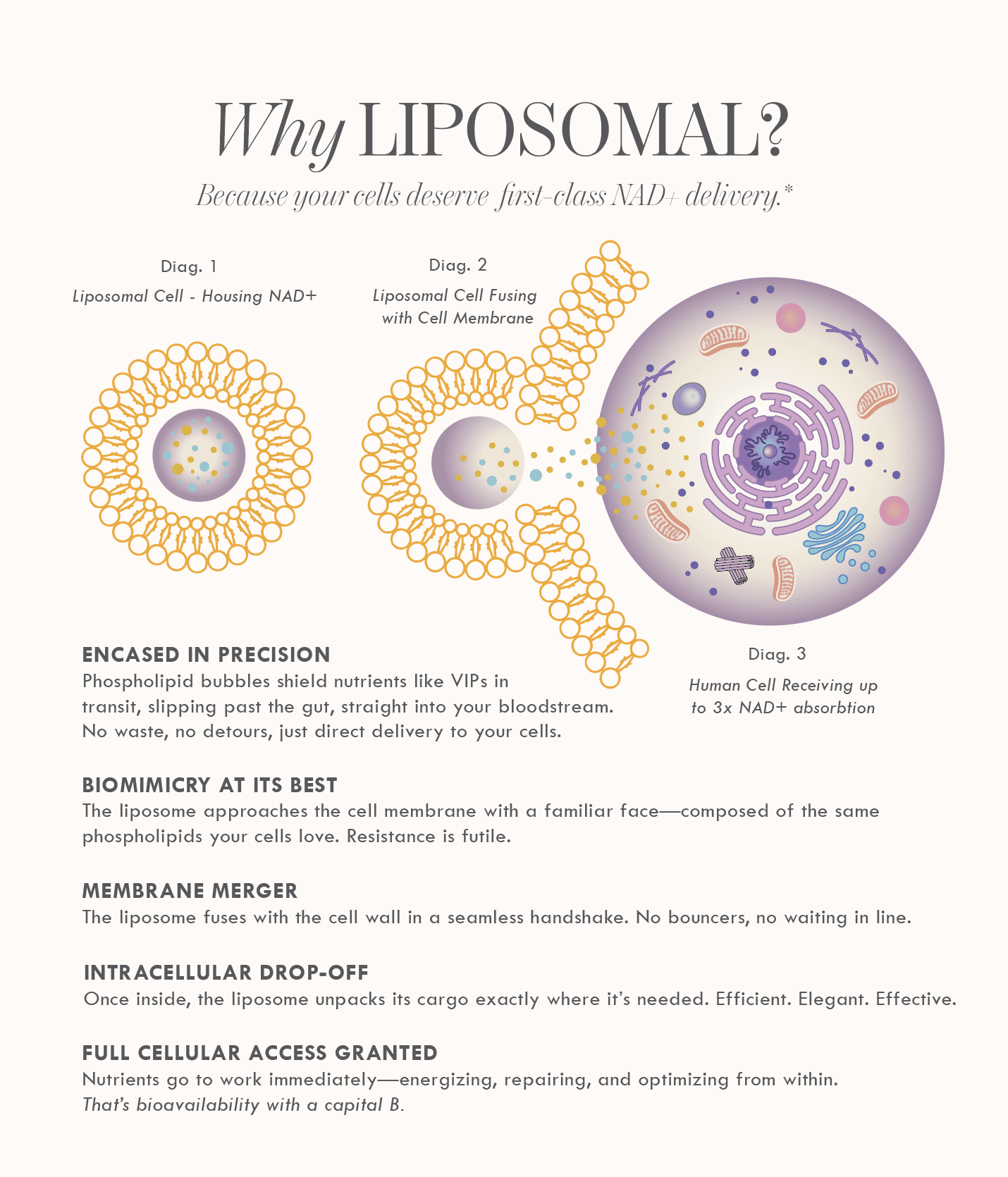
Liposomes are microscopic spheres made of phospholipids, the same material your cell membranes are made of. This allows them to shield their contents from digestive breakdown and improve interaction with biological membranes.

Think of liposomes as biological compatibility tools. They don’t force entry. They integrate.

Research across nutraceuticals and pharmaceuticals consistently shows that liposomal delivery can significantly improve bioavailability compared to standard oral forms. Studies with liposomal vitamins and antioxidants demonstrate faster absorption, higher plasma levels, and improved stability. Further data support this principle, showing nearly two-fold improvements in bioavailability for compounds encapsulated in liposomes compared to conventional formulations.

The delivery principle is consistent: lipid-based carriers improve systemic exposure for hard-to-absorb molecules.

From a cellular standpoint, this matters. Cell membranes recognize lipids. They evolved to interact with them.

And so liposomal NAD+ aligns with how cells actually work, not how supplement shelves are organized.

Liposomal delivery improves the odds that NAD+ survives digestion and reaches the cell intact.

IV, Sublingual, and Supplement Forms: How Do They Compare?

Not all delivery methods are created equal. Each has strengths and limitations.

IV NAD+ delivers compounds directly into circulation, bypassing digestion entirely. It is effective but expensive, time-intensive, and impractical for daily use.

Sublingual NAD+ bypasses part of the digestive system and offers faster absorption than capsules, but dosage consistency and depth of cellular delivery vary.

Standard oral supplements are convenient and accessible, but suffer from low and inconsistent bioavailability.

Liposomal oral NAD+ sits at the intersection: non-invasive, practical for daily use, and designed to improve absorption at the cellular level.

From an optimization standpoint, the goal isn’t intensity — it’s consistency.


Liposomal NAD+ offers the best balance of effectiveness, safety, and sustainability.

The Cell Theory Approach: Formulating for Cells, Not Trends

Most supplements are designed to look good on labels. Cell Theory is designed to work inside cells.

The Cell Theory Triple Action NAD+ formula uses liposomal NAD+ as part of a broader, multi-pathway approach. Instead of relying on a single mechanism, it supports NAD+ availability, mitochondrial function, and oxidative balance simultaneously.

Ingredients like NADH and niacinamide support NAD+ pathways. Compounds such as quercetin and apigenin are included for their roles in cellular signaling and NAD+ preservation. Alpha-lipoic acid and ergothioneine contribute to mitochondrial resilience and redox balance.

This is not about chasing one molecule. It’s about supporting the environment NAD+ operates in.

I personally follow this framework because cells don’t respond to shortcuts; they respond to signals, repeated daily.

And so Cell Theory doesn’t try to overwhelm the system. It works with it.

The most effective NAD+ strategy supports delivery, preservation, and cellular context together.

Delivery Determines Destiny

If there’s one lesson longevity science keeps reinforcing, it’s this: cells decide outcomes.

You can take the right molecule in the wrong form and get nothing. Or you can respect cell biology and let the system do what it was designed to do.

And so when it comes to NAD+, the question isn’t whether it works. The question is whether it ever arrives.

Choose delivery methods that align with cellular reality. That’s how you turn supplementation into optimization.

Longevity isn’t about taking more. It’s about delivering better. Build your NAD+ strategy the way cells were designed to receive it.